
How Profitable Should an MSP Be? 2027 Financial Benchmarks Every Owner Should Know
Revenue growth does not automatically mean a healthier MSP. As owners plan for 2027, the better question is whether revenue, gross profit, operating profit, and cash are moving together—and whether leadership understands why. How profitable should an MSP be in…
Revenue growth does not automatically mean a healthier MSP. As owners plan for 2027, the better question is whether revenue, gross profit, operating profit, and cash are moving together—and whether leadership understands why.
How profitable should an MSP be in 2027?
There is no single profit margin that fits every managed service provider. A useful profitability benchmark compares your own gross margin, operating profit, cash flow, and service-line economics over time, then tests those results against your pricing, staffing, client mix, and growth strategy. Set targets based on your business model rather than adopting an unsupported industry-wide percentage.
What Next Level Now client results reveal
In Next Level Now’s client performance presentation, the median change across comparable client results was +11.4% in revenue, +8.2% in gross profit, and +13.0% in net operating income/operating profit. These are changes in client results—not gross margin percentages, EBITDA margins, or industry averages. The presentation does not specify the comparison period or sample methodology, so these figures should not be interpreted as guaranteed outcomes.
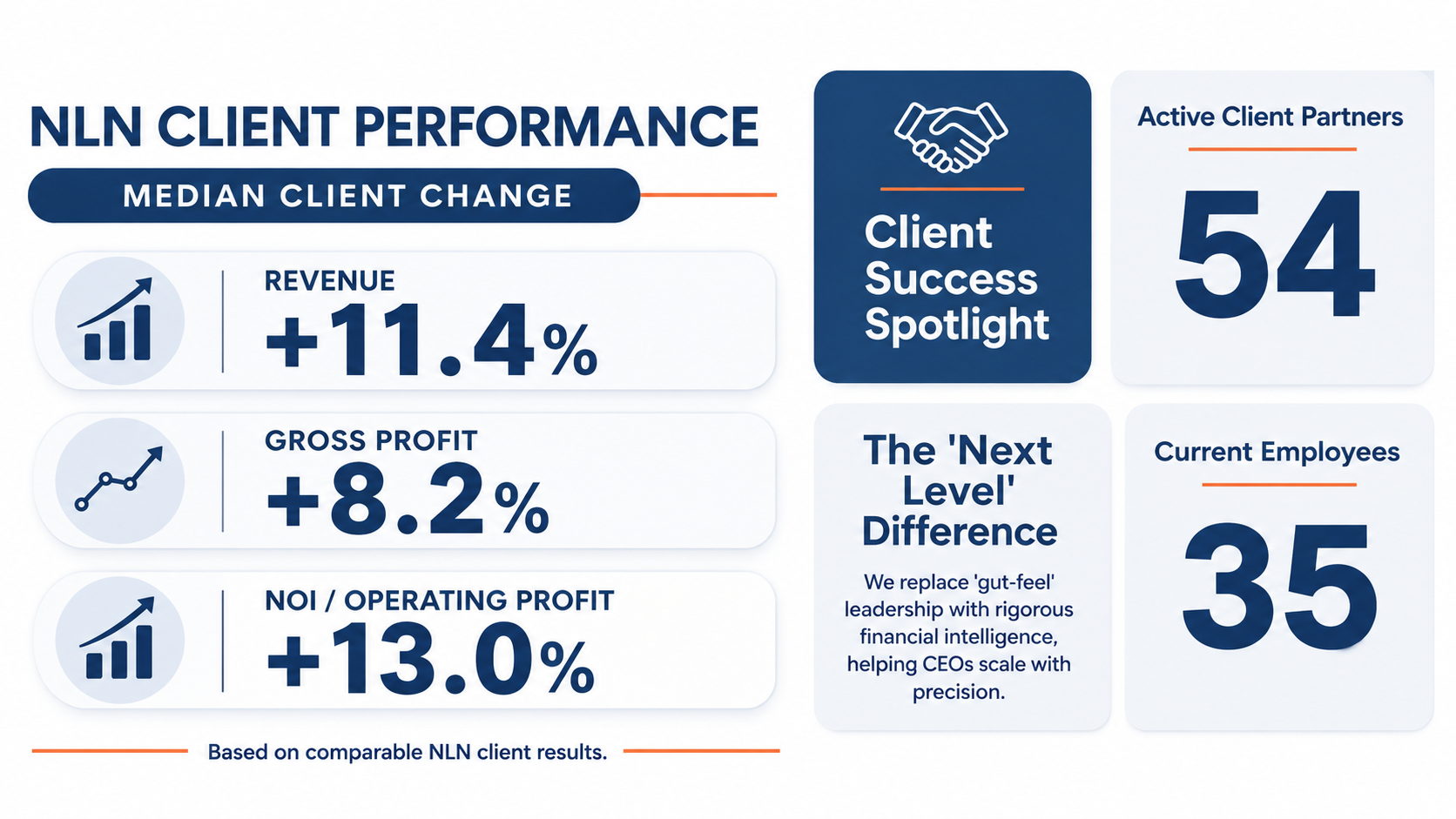
Original slide: NLN Client Performance — From Bookkeeper to Strategic CFO, slide 2.
The distinction matters. Revenue can rise while gross profit lags, and operating profit can change at a different rate again. Owners need to examine each layer of performance instead of relying on top-line growth alone.
The five financial benchmarks MSP owners should review
1. Gross profit and gross margin
Gross profit is revenue less direct service delivery costs. Gross margin = gross profit ÷ revenue × 100. Review it by managed services, projects, and resale rather than only at the company level.
2. Operating profit and EBITDA
Operating profit shows what remains after operating expenses; EBITDA adds back interest, taxes, depreciation, and amortization as applicable. They are not interchangeable. Track trends consistently and understand any adjustments.
3. Client and service-line profitability
Two clients can each pay $10,000 a month yet consume radically different support capacity. Compare revenue with labor, tools, ticket demand, escalations, and scope to understand contribution.
4. Labor capacity and efficiency
Before hiring another technician, examine ticket volume, endpoints, projects, skill mix, process, and automation. Model the financial consequences of hiring, reassigning, automating, or repricing.
5. Cash flow and forecast accuracy
Profit on the P&L does not guarantee available cash. Review collections, upcoming commitments, cash requirements, and rolling forecasts so growth decisions do not create surprises.
Where did the margin go? Follow the operating drivers
As Brandi Bonds explains in her IT Nation COO Group presentation, “The P&L identifies the symptom. The operating data identifies the lever.” A decline in gross margin should trigger a review of pricing, scope, labor mix, tools, project leakage, and client behavior—not merely another financial report.
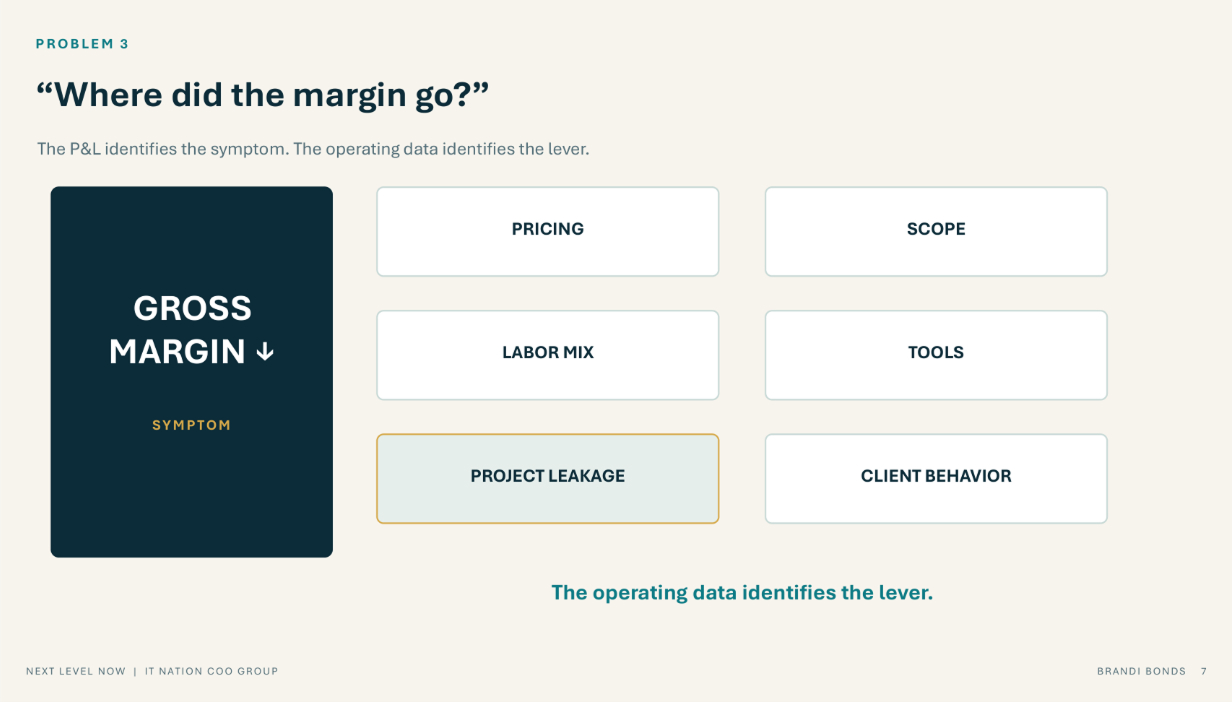
Original slide: “Where did the margin go?” — Give Finance a Problem to Solve, slide 7.
A practical 2027 profitability review cadence
Make financial review an operating habit. The presentation recommends weekly checks of backlog, capacity, ticket shifts, and exceptions; monthly reviews of client margins, service lines, labor, and tools; and quarterly decisions about pricing, staffing, automation, and client mix. Each meeting should end with a decision, owner, date, and measure.
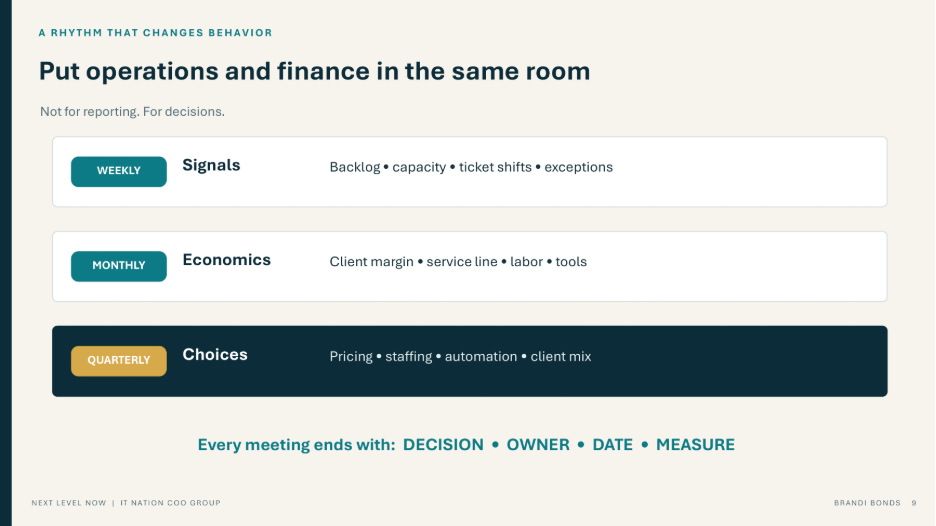
Original slide: “Put operations and finance in the same room” — Give Finance a Problem to Solve, slide 9.
What should your finance team deliver each month?
Next Level Now describes a five-part management system: CLOSE accurate books; REPORT financial statements and profitability; EXPLAIN drivers of revenue, gross margin, labor, EBITDA, and cash; FORECAST the implications of risks and capacity; and ACT with clear accountability. The objective is fewer surprises and better decisions—not reporting for its own sake.
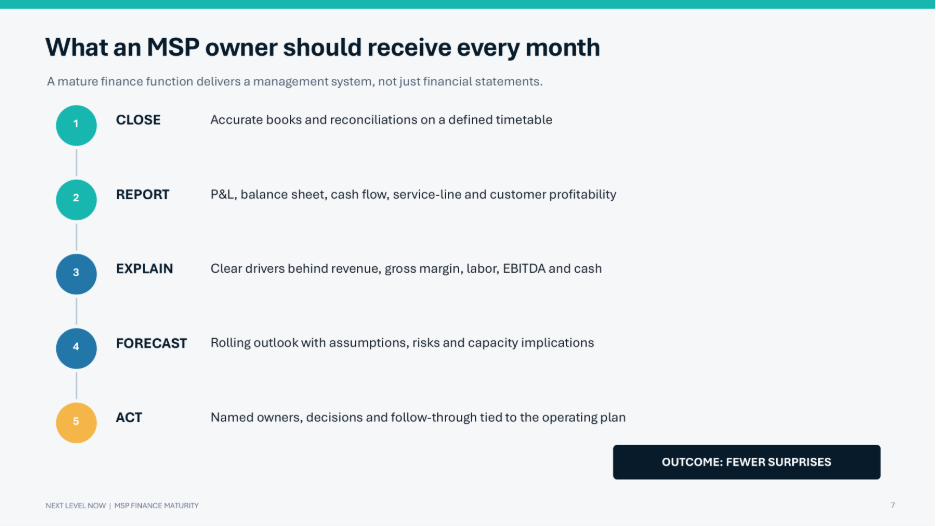
Original slide: “What an MSP owner should receive every month” — From Bookkeeper to Strategic CFO, slide 7.
Frequently asked questions
What is a good MSP profit margin?
There is no universal answer. Compare gross margin and operating profit with your own historical results, service mix, staffing model, and investment plans. Use like-for-like peer data only when its definitions and sample are clear.
Is revenue growth enough to show an MSP is healthy?
No. Revenue can grow while delivery costs and overhead rise faster. Gross profit, operating profit, and cash flow provide a more complete picture.
How often should MSPs review profitability?
Monitor operating signals weekly, financial economics monthly, and strategic choices quarterly, with a rolling forecast updated as assumptions change.
When should an MSP bring in a fractional CFO?
When leadership needs forward-looking models for pricing, staffing, cash, acquisitions, or growth—and accurate books alone no longer answer what to do next.
Build a more profitable MSP in 2027
The goal for 2027 should not be to chase a single headline margin. It should be to understand where profitability is created or lost, connect finance with operations, and turn that understanding into decisions. Next Level Now helps MSP owners bring clarity to financial performance through accounting, controller, and strategic CFO leadership. Connect with Next Level Now to build a financial plan grounded in the realities of your MSP.
Contact Next Level Now to start the conversation!
Continue learning with Next Level insights

Evolve 2026 Recap: 6 Financial Leadership Takeaways for MSPs
What can Managed Service Providers (MSPs) do to improve profitability, strengthen financial operations, and make better business decisions? At Evolve 2026, MSP leaders explored how…

Next Level Now Heads to IT Nation Connect Global 2026
Next Level Now is heading to Orlando for IT Nation Connect Global 2026! Our CEO, Brandi Bonds, will be joining MSP leaders and industry peers…

Next Level Now CEO Brandi Bonds Shares Financial Leadership Insights at Provarro Forge 2026
Next Level Now CEO Brandi Bonds joined MSP leaders in Arlington, Virginia, for Provarro Forge 2026, delivering a keynote presentation and leading finance-focused breakout sessions…
Let’s Build the Right Financial Strategy Together
Tell us about your business, and we’ll guide you toward the best level of CFO and accounting support tailored to your growth stage.

Choose your starting point today and scale as your company grows.
Our team will reach out to discuss your needs and design a financial plan that works for you.
"*" indicates required fields