
Evolve 2026 Recap: 6 Financial Leadership Takeaways for MSPs
What can Managed Service Providers (MSPs) do to improve profitability, strengthen financial operations, and make better business decisions? At Evolve 2026, MSP leaders explored how stronger financial leadership can help answer those questions. From improving billing accuracy and technician utilization…
What can Managed Service Providers (MSPs) do to improve profitability, strengthen financial operations, and make better business decisions?
At Evolve 2026, MSP leaders explored how stronger financial leadership can help answer those questions. From improving billing accuracy and technician utilization to evaluating automation investments and new AI service offerings, the conversations reinforced an important message:
Financial data is most valuable when it drives action.
The Next Level Now team contributed to discussions about connecting finance with daily operations and building the right financial capabilities as an MSP grows.
Here are six key takeaways MSP owners and leadership teams can apply to their businesses.
1. Connect Financial Leadership to Everyday MSP Operations
Financial leadership helps MSPs turn operational challenges into informed business decisions.
When an MSP experiences rising ticket volumes, staffing challenges, or declining service margins, the first instinct is often to look for an operational solution.
But financial insight can reveal opportunities that aren’t immediately obvious.
Consider an MSP that believes it needs another technician. Before making that investment, leadership should evaluate:
- Service demand: Are ticket volumes, endpoints, or project workloads increasing?
- Existing capacity: Are technicians being utilized effectively?
- Financial impact: How would another hire affect labor costs, cash flow, and profitability?
- Alternative solutions: Could automation, resource allocation, or process improvements address the challenge?
The same approach applies to client profitability, project overruns, and service delivery inefficiencies.
When finance and operations work together, MSPs can evaluate the financial implications of their decisions before committing resources.
Key takeaway: Give finance a business problem to solve, not just another report to produce.
2. Improve Financial Visibility by Connecting PSA and Accounting Data
Accurate financial reporting starts with reliable data across an MSP’s business systems.
Managed Service Providers rely on professional services automation (PSA) platforms, accounting software, and other business management tools to track performance.
However, when those systems aren’t properly aligned, financial reporting can become unreliable.
At Evolve, discussions highlighted several important areas of MSP financial management:
- Reconciling revenue between PSA and accounting systems.
- Accurately allocating technician labor costs.
- Identifying billing discrepancies and missed revenue.
- Analyzing financial variances to understand changes in performance.
- Evaluating profitability across clients and service lines.
For example, if an MSP’s accounting system reports healthy revenue but its PSA data reveals excessive service hours for certain clients, leadership may be overlooking profitability challenges.
Connecting operational and financial data provides a clearer picture of where the business is performing well and where improvements are needed.
Key takeaway: Financial visibility depends on accurate data, consistent processes, and alignment between finance and operations.
3. Measure the Financial Impact of MSP Automation
Automation should do more than reduce manual tasks. It should create measurable business value.
Automation continues to reshape MSP operations, including accounting and financial management.
Many routine finance activities have been automated for years. Today, additional opportunities exist to streamline labor allocation, revenue reconciliation, and financial variance analysis.
But implementing automation doesn’t automatically mean an MSP is becoming more profitable.
Leadership should evaluate whether automation investments are delivering meaningful results.
Questions worth asking include:
- Are we reducing manual work and administrative costs?
- Is automation improving billing accuracy?
- Are employees gaining capacity for higher-value activities?
- Are we identifying financial issues sooner?
- Is the investment improving efficiency, profitability, or risk management?
Financial leaders can help quantify these improvements and determine whether automation initiatives are delivering the expected return.
Key takeaway: The value of automation isn’t simply the work it replaces. It’s the efficiency, capacity, and financial improvement it creates.
4. Forecast the Financial Opportunity Before Launching AI Services
Every MSP wants to get into AI, but building a profitable AI practice requires more than enthusiasm. It requires a financial model.
Before launching an AI division or expanding into AI services, MSP leaders should forecast potential revenue, startup costs, ongoing expenses, pricing strategies, and expected profitability. How much client demand is realistic? What investments in talent, tools, and training will be required? When will the new offering break even, and what resources will be needed to scale?
Building multiple financial scenarios helps MSP owners understand the potential return on investment, evaluate risks, and make informed decisions before committing significant resources.
Key takeaway: Don’t just launch AI services because the market is moving in that direction. Model the opportunity first to build an AI practice that’s both innovative and financially sustainable.
5. Establish a Financial and Operational Decision-Making Rhythm
MSPs benefit from regularly bringing finance and operations together to review performance and make decisions.
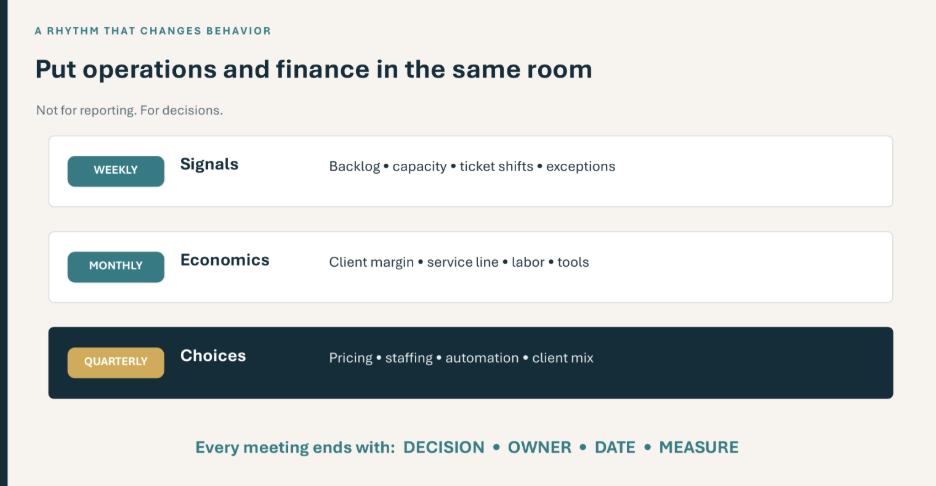
One practical recommendation from Evolve was to establish a consistent cadence for financial and operational collaboration.
Rather than waiting until month-end to review results, MSP leaders can use a structured approach to identify challenges earlier and make more informed decisions.
Weekly: Monitor Operational Performance
Review ticket trends, service demand, technician capacity, and operational exceptions to identify potential issues before they affect financial results.
Monthly: Evaluate Financial Performance
Analyze client profitability, labor costs, service-line margins, and cash flow to understand what’s driving business performance.
Quarterly: Make Strategic Business Decisions
Evaluate larger opportunities involving staffing, pricing, automation investments, and client mix.
Each discussion should end with clear action items, assigned ownership, timelines, and measurable outcomes.
This approach helps financial information become part of everyday business management rather than simply a historical record.
Key takeaway: A consistent decision-making rhythm helps MSPs connect financial insights to operational improvements and accountability.
6. Build the Right Financial Capabilities for Your MSP’s Next Stage
The financial expertise an MSP needs depends on its operational complexity, business goals, and upcoming decisions, not revenue alone.
As Managed Service Providers grow, their financial needs become more complex.
Some businesses need stronger accounting processes and more reliable reporting. Others need deeper profitability analysis, financial forecasting, or strategic guidance.
Signs that an MSP may need to strengthen its finance function include:
- Financial reporting is consistently delayed or inaccurate.
- PSA and accounting information don’t reconcile.
- Leadership struggles to explain client or service-line profitability.
- Hiring and compensation decisions lack financial modeling.
- Cash flow surprises occur despite reported profitability.
- Growth, financing, or acquisition opportunities require more sophisticated planning.
The goal isn’t necessarily to add another full-time financial employee. It’s to identify which financial capabilities would create the greatest value.
For MSP owners, three questions can help guide that decision:
- What business decisions are we making without enough financial clarity?
- Where are our current financial processes or capabilities falling short?
- What additional financial expertise would create the greatest impact right now?
Answering these questions helps leadership prioritize improvements and build a finance function that supports future growth.
Key takeaway: Build the financial capabilities your next business decisions require.
What Should MSP Leaders Take Away From Evolve 2026?
The conversations at Evolve reinforced that effective MSP financial management requires more than accurate accounting and timely reports.
It requires collaboration between finance and operations, reliable business data, thoughtful financial forecasting, and a willingness to turn insights into action.
For MSP owners, the next step doesn’t have to be a major organizational change. It might start with improving billing accuracy, evaluating technician capacity, modeling a new AI service offering, or bringing financial expertise into an upcoming operational decision.
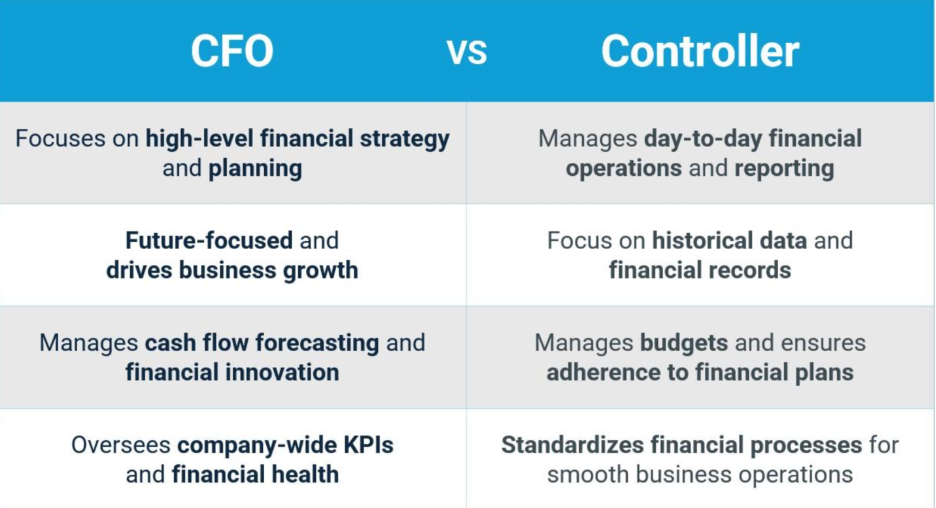
At Next Level Now, we work alongside MSP owners and leadership teams to connect financial expertise with operational priorities. Through embedded financial leadership, controller support, and strategic CFO guidance, we help MSPs strengthen financial visibility, improve profitability, and make more confident business decisions.
The question isn’t just, “What do our financial reports tell us?” It’s, “What should we do next?”
Connect with Next Level Now to learn how the right financial leadership can help your MSP move forward.
Contact Next Level Now to start the conversation!
Continue learning with Next Level insights

Next Level Now Heads to IT Nation Connect Global 2026
Next Level Now is heading to Orlando for IT Nation Connect Global 2026! Our CEO, Brandi Bonds, will be joining MSP leaders and industry peers…

Next Level Now CEO Brandi Bonds Shares Financial Leadership Insights at Provarro Forge 2026
Next Level Now CEO Brandi Bonds joined MSP leaders in Arlington, Virginia, for Provarro Forge 2026, delivering a keynote presentation and leading finance-focused breakout sessions…

Controller vs. CFO vs. Bookkeeper: Why Your MSP Needs More Than Just the Numbers
Accurate financial reporting is essential. But turning those numbers into better decisions, stronger profitability, and sustainable growth requires strategic financial leadership. For many managed service…
Let’s Build the Right Financial Strategy Together
Tell us about your business, and we’ll guide you toward the best level of CFO and accounting support tailored to your growth stage.

Choose your starting point today and scale as your company grows.
Our team will reach out to discuss your needs and design a financial plan that works for you.
"*" indicates required fields