
The Rule of 40 for MSPs: Why Growth Alone Doesn’t Tell the Whole Story
For managed service providers, revenue growth alone doesn’t tell you whether the business is getting stronger. An MSP can grow quickly while margins shrink, service delivery becomes less efficient, and new clients consume more resources than expected. On the other…
For managed service providers, revenue growth alone doesn’t tell you whether the business is getting stronger.
An MSP can grow quickly while margins shrink, service delivery becomes less efficient, and new clients consume more resources than expected. On the other hand, an MSP can produce strong profits while growth slows because the business isn’t investing enough in sales, marketing, people, or capacity.
That’s where the Rule of 40 can provide a useful framework.
The Rule of 40 is commonly associated with SaaS companies, but MSPs operate under a very different business model. Rather than treating 40% as a universal benchmark, MSP leaders can use the concept to have a better conversation about the relationship between revenue growth and profitability.
What Is the Rule of 40?
The traditional Rule of 40 combines a company’s revenue growth rate and profit margin:
Revenue Growth % + Profit Margin % = 40% or more
For example:
- 30% revenue growth + 10% profit margin = 40%
- 20% revenue growth + 20% profit margin = 40%
- 10% revenue growth + 30% profit margin = 40%
The concept recognizes that businesses often make a tradeoff between growth and profitability.
A rapidly growing company may accept lower profitability because it is investing heavily in future growth. A slower-growing company may be expected to produce stronger margins.
That framework can be useful for MSPs, but there’s an important distinction.
Why the Rule of 40 Is Different for MSPs vs. SaaS Companies
The traditional Rule of 40 was developed around the economics of software companies.
A SaaS company can often add customers without increasing its workforce or operating expenses at the same rate. Once the software platform has been built, the incremental cost of serving another customer can be relatively low.
MSPs don’t have the same economics.
Managed services may generate recurring revenue, but they are still heavily dependent on people and service delivery.
As an MSP grows, it may need additional:
- Service desk technicians
- Engineers
- Account managers
- Service managers
- Sales and marketing resources
- Security tools and software licenses
- Operational infrastructure
That means adding another $1 million of recurring revenue can have a very different financial impact for an MSP than adding another $1 million of recurring revenue for a SaaS company.
This is why MSP leaders should avoid treating the Rule of 40 as a simple pass/fail metric.
The MSP Growth + Profit Matrix
A more useful approach is to look at revenue growth and profit margin together.
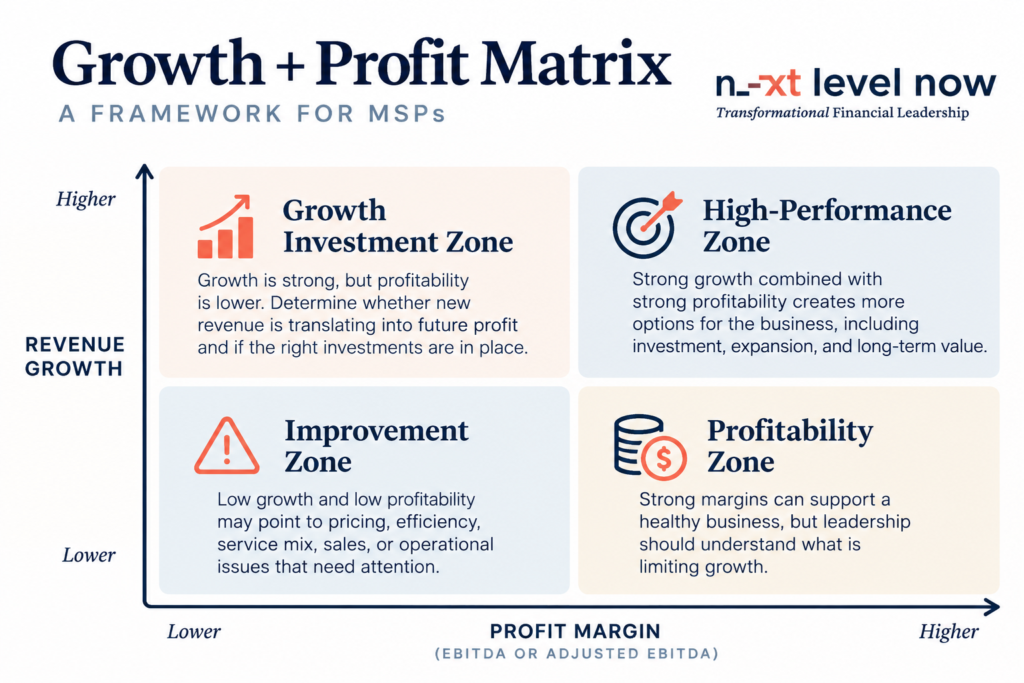
The goal isn’t necessarily to stay in one quadrant every year.
The important question is:
Does leadership understand why the MSP is where it is and whether that position supports the company’s strategy?
Not All MSP Revenue Growth Is Profitable Growth
Consider two MSPs that both grow revenue by 20%.
At first glance, their performance looks similar.
MSP A adds managed services clients that fit its existing technology stack, pricing model, service capabilities, and ideal client profile.
MSP B wins several large clients at aggressive prices. Those clients require additional technicians, new tools, significant onboarding resources, and more service hours than originally anticipated.
Both MSPs achieved 20% revenue growth.
But the financial impact of that growth could be dramatically different.
That’s why MSP leaders shouldn’t only ask:
How fast are we growing?
They should also ask:
How profitable is the growth we’re creating?
High Profitability Doesn’t Always Mean an MSP Is Healthy
The opposite can also happen.
An MSP may improve profitability in the short term by delaying hiring, reducing marketing investment, postponing technology upgrades, or asking its existing team to absorb additional work.
Margins may improve.
But those decisions could also limit future growth, create capacity constraints, or negatively affect service delivery.
Strong financial leadership requires understanding what is driving the margin, not simply celebrating a higher percentage.
Two MSPs Can Hit the Rule of 40 in Very Different Ways
Consider these two examples:
MSP A: Higher Growth
Revenue Growth: 25%
Profit Margin: 15%
Combined: 40%
This MSP may be aggressively acquiring new customers while investing in additional people, sales, marketing, and infrastructure.
MSP B: Higher Profitability
Revenue Growth: 10%
Profit Margin: 30%
Combined: 40%
This MSP may be a more mature provider generating strong margins and cash flow while growing at a slower rate.
Both equal 40%.
But they require very different financial conversations.
The Rule of 40 tells you where the business landed. It doesn’t necessarily tell you why it landed there.
What Financial Metrics Should MSPs Track Alongside the Rule of 40?
Rather than relying on one number, MSP leadership teams should evaluate the Rule of 40 alongside other MSP financial KPIs.
Questions worth asking include:
- What is our organic revenue growth rate?
- How much growth is coming from recurring managed services revenue?
- What is our EBITDA or adjusted EBITDA margin?
- Are gross margins improving as revenue increases?
- What is our revenue per employee?
- Are new managed services agreements being priced at appropriate margins?
- How much service capacity do we have before our next hire?
- Are sales and marketing investments producing profitable growth?
- Are we intentionally sacrificing profitability to support growth?
- If margins are declining, do we understand why?
These questions help turn financial reporting into financial leadership.
How MSPs Can Use the Growth + Profit Matrix for Financial Planning
The Growth + Profit Matrix becomes even more useful when you use it to look forward rather than backward.
Plot your MSP’s revenue growth and profitability for the past three to five years.
Then plot where you expect the business to be next year.
If your MSP is targeting 20% growth, ask what needs to happen financially and operationally to support it.
How many new clients will you need?
When will you need to hire?
What gross margin must you maintain?
How much should you invest in sales and marketing?
How will increased revenue affect cash flow?
What service delivery improvements will be necessary?
Most importantly:
What has to be true for the financial plan to work?
That is where a simple benchmark becomes a strategic planning tool.
The Rule of 40 Is a Framework, Not an MSP Strategy
The Rule of 40 is appealing because it combines two important business metrics into one simple calculation.
But an MSP cannot be managed by a single percentage.
Revenue growth, profitability, gross margin, labor efficiency, pricing, capacity, service delivery, and cash flow all work together.
A combined growth-and-profit figure of 40% doesn’t automatically mean everything is working. Falling below 40% doesn’t automatically mean an MSP is unhealthy, either.
What matters is understanding why the numbers are moving and whether they align with the company’s goals.
At Next Level Now, we help MSP leadership teams move beyond financial reporting to understand what their numbers mean, where the business is headed, and what financial decisions can support sustainable, profitable growth.
Are your financials simply telling you what happened, or helping you decide what happens next?
Contact Next Level Now to start the conversation!
Continue learning with Next Level insights

The Difference Between Tracking the Numbers and Actually Improving Them
Every business has financial data. Revenue. Expenses. Gross profit. Cash flow. Operating profit. The question is not whether you have the numbers. It is whether…

Strategic CFO Course: Becoming The CFO Every CEO Wants At The Table
The role of the CFO is changing. Finance leaders are no longer expected to simply close the books, prepare reports, and explain what happened. Today’s…

What Is a CFO? And Does Your MSP Actually Need One?
As an MSP owner, you’ve probably asked yourself questions like: If those questions sound familiar, you may not have a bookkeeping problem. You may have a financial leadership problem. …
Let’s Build the Right Financial Strategy Together
Tell us about your business, and we’ll guide you toward the best level of CFO and accounting support tailored to your growth stage.

Choose your starting point today and scale as your company grows.
Our team will reach out to discuss your needs and design a financial plan that works for you.
"*" indicates required fields