
The Difference Between Tracking the Numbers and Actually Improving Them
Every business has financial data. Revenue. Expenses. Gross profit. Cash flow. Operating profit. The question is not whether you have the numbers. It is whether those numbers are helping you make better decisions. There is an important difference between financial…
Every business has financial data.
Revenue. Expenses. Gross profit. Cash flow. Operating profit.
The question is not whether you have the numbers. It is whether those numbers are helping you make better decisions.
There is an important difference between financial reporting and financial leadership. Reporting tells you what happened. Financial leadership helps you understand why it happened, what it means for the business, and what you should do next.
That distinction can have a measurable impact on performance.
Revenue Growth Doesn’t Tell the Whole Story
Revenue is often the first number business leaders look at when evaluating growth. And understandably so. More revenue generally means the company is selling more.
But revenue growth alone does not necessarily mean the business is becoming more profitable.
A company can increase sales while simultaneously dealing with rising labor costs, inefficient operations, pricing problems, unnecessary overhead, or declining margins. From the outside, the company appears to be growing. Behind the scenes, profitability may be moving in the opposite direction.
That is why strong financial leadership looks beyond the top line.
Revenue, gross profit, and operating profit should be evaluated together to provide a clearer picture of whether growth is actually creating value.
Industry Averages Are a Starting Point, Not a Strategy
Financial benchmarks can be incredibly useful.
Comparing your company’s margins, expenses, labor costs, revenue growth, and profitability against industry averages can help identify areas where the business may be outperforming or falling behind its peers.
But knowing the benchmark is only the beginning.
Suppose your gross profit margin is below the industry average. That tells you there may be an opportunity for improvement, but it does not tell you why the gap exists.
Is pricing too low?
Are certain customers or service lines less profitable than expected?
Are labor costs increasing faster than revenue?
Has the company’s service mix changed?
Are operational inefficiencies cutting into margins?
This is where financial leadership becomes critical. A benchmark identifies the gap. Financial leadership determines what to do about it.
Moving From Financial Reporting to Financial Leadership
Traditional financial reporting is primarily backward-looking.
It answers questions such as:
What did we earn last month? How much did we spend? Did we hit budget? What was our profit?
Those are important questions, but leadership requires another layer of analysis.
A strategic financial leader should also be asking:
- Which customers, products, or services are generating the strongest margins?
- Where is profitability being lost?
- Are expenses growing faster than revenue?
- Is our pricing supporting our profitability goals?
- Where should we invest additional resources?
- What changes could improve cash flow?
- What financial trends could create challenges six or twelve months from now?
Instead of simply reporting the numbers, financial leadership turns those numbers into decisions.
What Happens When Financial Insight Drives Decisions?
The impact can show up throughout the business.
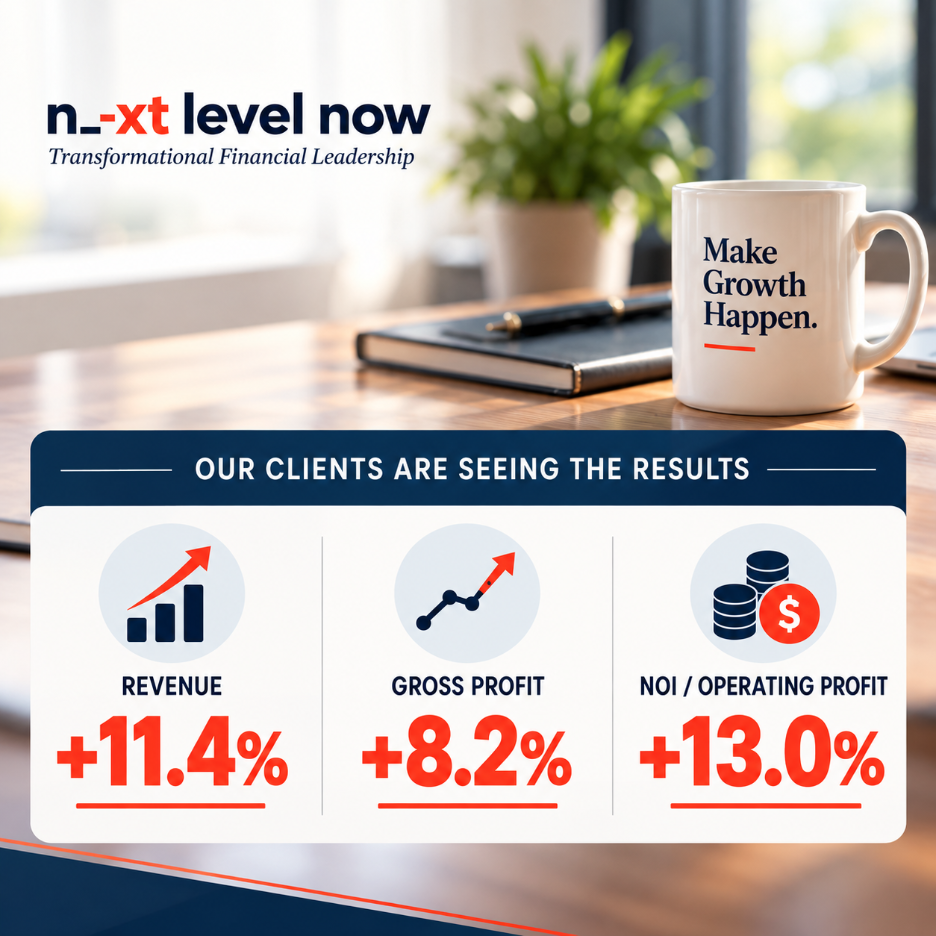
At Next Level Now, our clients are seeing measurable improvements across three important financial indicators:
11.4% increase in revenue
8.2% increase in gross profit
13.0% increase in operating profit
These numbers matter together.
Revenue growth shows that the business is expanding. Gross profit growth demonstrates that additional value is being generated after the direct costs of delivering products or services. Operating profit growth shows that improvement is making its way further down the income statement.
Ultimately, the goal is not simply to make a business bigger.
It is to make it stronger, more profitable, and more valuable.
Better Financial Leadership Creates Better Conversations
One of the biggest benefits of strategic financial leadership happens before a decision is made.
Should we hire another employee?
Can we afford to invest in new technology?
Should we increase prices?
Which service line deserves additional investment?
Can we open another location?
How much cash should we keep available?
Where should we cut costs without limiting growth?
Without strong financial insight, these decisions can become educated guesses.
With the right financial leadership, management can evaluate the potential financial impact, understand the tradeoffs, and make decisions with greater confidence.
Finance becomes part of the strategy rather than simply the department that reports the results afterward.
Your Financials Should Help You See What’s Coming
Historical financial statements will always be important. But today’s numbers become much more valuable when they help leadership prepare for tomorrow.
Forecasting, scenario planning, cash flow management, profitability analysis, and financial modeling allow businesses to look ahead and ask better questions.
What happens if revenue grows 15%?
What happens if we add five employees?
What happens if a major customer leaves?
What happens if margins decline by three points?
What happens if we make that investment now rather than next year?
The earlier leadership can see the financial implications of a decision, the more options the business has.
The Goal Isn’t Better Reporting. It’s a Better Business.
A clean financial report
is useful. A financial leader who can translate those numbers into action is far more valuable.
The strongest businesses do not just know their numbers. They understand what is driving them, where opportunities exist, what risks are emerging, and which decisions are most likely to improve performance.
That is the difference between tracking the numbers and actually improving them.
At Next Level Now, we help businesses turn financial insight into strategic action, with a focus on stronger profitability, better decision-making, and sustainable business value.
Are your financials simply telling you what happened, or helping you decide what happens next?
Contact Next Level Now to start the conversation!
Continue learning with Next Level insights

The Rule of 40 for MSPs: Why Growth Alone Doesn’t Tell the Whole Story
For managed service providers, revenue growth alone doesn’t tell you whether the business is getting stronger. An MSP can grow quickly while margins shrink, service…

Strategic CFO Course: Becoming The CFO Every CEO Wants At The Table
The role of the CFO is changing. Finance leaders are no longer expected to simply close the books, prepare reports, and explain what happened. Today’s…

What Is a CFO? And Does Your MSP Actually Need One?
As an MSP owner, you’ve probably asked yourself questions like: If those questions sound familiar, you may not have a bookkeeping problem. You may have a financial leadership problem. …
Let’s Build the Right Financial Strategy Together
Tell us about your business, and we’ll guide you toward the best level of CFO and accounting support tailored to your growth stage.

Choose your starting point today and scale as your company grows.
Our team will reach out to discuss your needs and design a financial plan that works for you.
"*" indicates required fields