
Compensation Chaos Is Costing You Talent: How MSPs Build Bonus Plans That Actually Work
For most MSPs, compensation is the largest controllable expense on the P&L. It’s also the most misunderstood. When compensation plans are unclear, misaligned, or copied from the wrong industries, they quietly erode gross profit, damage morale, and drive away your…
For most MSPs, compensation is the largest controllable expense on the P&L. It’s also the most misunderstood.
When compensation plans are unclear, misaligned, or copied from the wrong industries, they quietly erode gross profit, damage morale, and drive away your best people. And in today’s market, losing an A-player doesn’t just hurt, it can cost up to four times their salary in replacement, ramp-up time, and lost productivity.
The good news? When done right, compensation becomes a growth engine.
At Next Level Now, we help MSPs design compensation plans that create a win for the company, a win for the employee, and a win for the customer.
Let’s break down how to build a plan that actually works.
Why Compensation Strategy Matters More Than You Think
Compensation isn’t just payroll. It drives behavior.
A well-designed plan:
- Aligns employees with company goals
- Protects gross profit and EBITDA
- Improves utilization
- Reduces employee turnover
- Decreases client churn
A poorly designed plan?
- Rewards the wrong behaviors
- Pays out bonuses when the company isn’t profitable
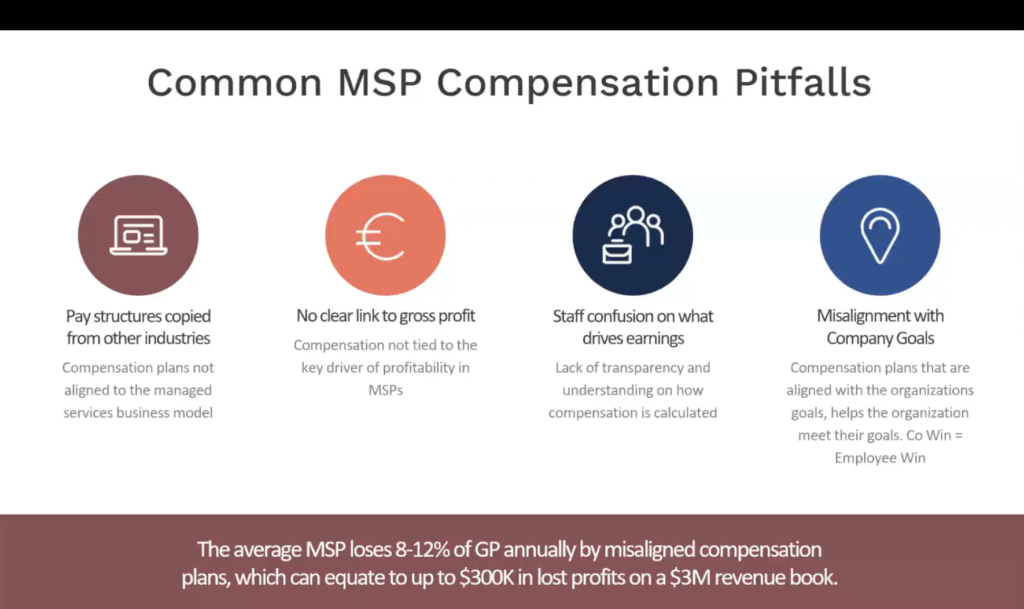
- Creates confusion about how bonuses are earned
- Costs you 8–12% of gross profit through misalignment
If your team doesn’t understand how they contribute to profitability, they can’t intentionally improve it. Clarity changes everything.
The Most Common MSP Compensation Mistakes
1. Copying Other Industries
MSPs are service businesses. Applying a manufacturing-style compensation plan to a services organization can be catastrophic.
Service businesses must tie incentives to:
- Gross margin
- Utilization
- Recurring revenue
- Operational maturity
2. Not Tying Bonuses to Profitability
If bonuses aren’t linked to gross profit or EBITDA thresholds, you risk paying out when the
Business isn’t healthy.
Variable compensation must have:
- A floor (minimum performance threshold)
- A target
- A ceiling (maximum payout guardrails)
No profitability? No bonus.
3. Annual-Only Bonus Structures
Annual bonuses create long feedback loops.
Quarterly payouts:
- Keep momentum high
- Increase engagement
- Help normalize performance
- Reduce surprise at year-end
The best plans allow employees to track their bonus progress monthly and know their payout before leadership even announces it.
That level of transparency builds trust.
The Framework: Align Compensation to Operational Maturity
High-performing MSPs align incentives to operational maturity benchmarks.
Instead of generic bonuses, compensation should be tied to:
- Gross margin dollars
- Gross margin percentage
- Utilization
- Upsells and cross-sells
- Customer retention
- Project delivery timelines
- Revenue growth (with guardrails)
- EBITDA thresholds
For example:
Account Managers (Farmers)
- 14–18% of direct compensation tied to gross margin dollars generated
- Upsell targets
- Operational improvement goals
New Logo Hunters
- 18–22% of gross profit
Sales Managers
- 15–20% tied to team GP performance
CEO Compensation
- Revenue growth targets (with minimums and maximums)
- Gross margin floor (e.g., no payout below 37%)
- EBITDA threshold (e.g., no payout below 9.99%)
This ensures compensation only accelerates growth when the business is healthy.
The Transparency Factor Most MSPs Avoid
Many owners hesitate to share gross profit or EBITDA with their teams.
But transparency builds ownership.
When employees understand:
- Where the company stands
- How their role impacts profitability
- What targets must be hit for bonuses
They behave differently.
When compensation becomes predictable and measurable, motivation shifts from guessing to executing.
Handling Market Shifts and Pay Equity
Post-COVID salary spikes created an imbalance across many MSPs. Some employees hired during peak market conditions now earn more than new hires in the same roles.
Here’s the practical approach:
- Review salaries annually against current market conditions.
- Protect A-players.
- Adjust compensation strategically, not emotionally.
- Shift more weight to variable compensation when appropriate.
And most importantly:
If you wouldn’t fight to keep someone, don’t inflate their salary to match market pressure.
Internal equity matters. Employees talk. Transparent salary bands and merit-based increases reduce pay envy and turnover.
The ROI of Getting Compensation Right
For a $5M MSP, even small improvements create a massive impact:
- Reduce turnover of one employee: $60K–$100K saved
- Improve utilization by 5 points: +2–5 points to the bottom line
- Prevent one client churn: $50K–$100K preserved
Collectively, strategic comp alignment can generate $200K–$290K in bottom-line improvement without adding new revenue.
This isn’t theoretical.
It’s operational leverage.
Compensation Isn’t Just Salary
Base pay ranks surprisingly low on why employees leave.
Retention drivers often include:
- Variable bonus clarity
- PTO flexibility
- 401(k) match
- Training & advancement paths
- Career growth
- Flex time
- Wellness benefits
Compensation is holistic. MSPs that highlight total rewards, not just salary, retain better talent.
The Bottom Line
When you take care of your employees, they take care of your customers.
When compensation:
- Is aligned to profitability
- Rewards controllable metrics
- Protects gross margin
- Pays out quarterly
- Is transparent
- Maintains internal equity
You create the win-win-win triangle:
Company wins.
Employees win.
Customers win.
And chaos becomes clarity.
Contact Next Level Now to start the conversation!
Continue learning with Next Level insights

Strategic CFO Course: Becoming The CFO Every CEO Wants At The Table
The role of the CFO is changing. Finance leaders are no longer expected to simply close the books, prepare reports, and explain what happened. Today’s…

What Is a CFO? And Does Your MSP Actually Need One?
As an MSP owner, you’ve probably asked yourself questions like: If those questions sound familiar, you may not have a bookkeeping problem. You may have a financial leadership problem. …

The Mid-Year Financial Reset: How Smart MSP Owners Prepare for a Strong Finish
If you’re like most MSP owners, January started with ambitious goals. You set revenue targets. Built a budget. Planned new hires. Identified growth initiatives. Maybe you even established quarterly Rocks to keep your team focused. …
Let’s Build the Right Financial Strategy Together
Tell us about your business, and we’ll guide you toward the best level of CFO and accounting support tailored to your growth stage.

Choose your starting point today and scale as your company grows.
Our team will reach out to discuss your needs and design a financial plan that works for you.
"*" indicates required fields